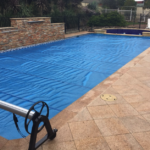
Buyers Guide to Pool Covers

Buyers Guide to buying Pool Covers
1. Solar Pool Covers
“Transparent covers were more effective in improving the water temperature than opaque covers because more solar energy could be obtained by the pool water when the transparent cover was used.” – Francey J.L.A, Golding P, Clarke R (1980) Low Cost Solar Heating of Community Pools using pool covers
California State Polytechnic University did a comparative evaporation study that tested multiple pool cover types it found that bubble covers along with foam covers and slat covers reduced evaporation by around 95% in controlled conditions. Whilst Solar Discs and Liquid methods were less effective.
The vast majority of the raw material manufacturers report that Solar pool covers reduce evaporation by up to 99%. For the average Australian backyard pool (approx 42,000L), this equates to approximately 3,500 litres of water saved per month, or more than 40,000 litres annually in warm or windy climates.
By preventing evaporation, solar pool covers significantly reduce chlorine and salt loss. Industry estimates show chemical usage reductions of 30–50%, as fewer chemicals are required to rebalance water lost through evaporation.
Solar covers are engineered to let short-wave radiation (UV, visible, and near-infrared light) pass through the cover and enter the pool water. This is the same portion of sunlight that actually warms the water when the sun shines directly on it. The key mechanisms are:
-
Short-wave transmission: The transparent/translucent material of a good solar cover transmits sunlight wavelengths that water readily absorbs, allowing the solar energy to become heat in the water rather than being reflected away.
-
Selective transmission and absorption: Some advanced covers are designed with wavelength-specific transmission characteristics — meaning they maximise transmission of heat-generating wavelengths while minimising the loss of that energy once warmed water re-emits it. This is the physical principle behind selective transmission materials studied in heat transfer research, which can increase absolute heating efficiency compared to non-selective opaque covers.
“Evaporation losses constitute the greatest heat loss from pools — 50 to 60% in most cases… A floating pool cover can reduce both radiation and evaporation losses… an enclosure can reduce this loss substantially, and a floating pool cover can practically eliminate the loss.”
“When a single layer clear plastic cover is placed on the water surface, the heat loss due to evaporation will cease while most of the incident solar radiation will be transmitted through the cover and absorbed in the water…”“A double layer cover with an air space between the layers … also reduces the convection and radiation heat losses.”
-
Preventing evaporation: The cover forms a barrier that stops water from escaping, which is critical because evaporative cooling accounts for up to 60% of total heat loss.
-
Allowing solar gain: Clear or translucent covers let sunlight pass through, warming the water while preventing heat from escaping.
-
Reducing convection and radiation: Multi-layer covers or air-bubble designs add insulation, further minimizing heat loss to the surrounding air and sky.
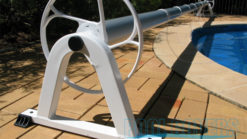
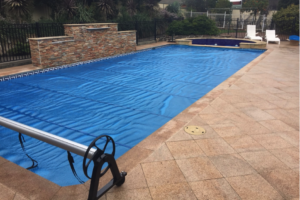
Solar pool covers are lightweight and flexible. A 500‑micron cover weighs approximately 500g per square metre, allowing most pools to be covered or uncovered in under 30 seconds when paired with a quality roller.
While not fully sealed, solar pool blanket significantly reduces leaf, dust, and insect contamination, lowering filtration and vacuuming requirements. The ability for a Solar Pool Cover to reduce the leaf and debris load is impacted significantly by the installation method. Long cuts, or installs that allow the material to curve up and under the coping will keep out significantly more material than Flush Cuts. A “tongue” cut into the skimmer box will then allow the leaf and debris to be hosed off the pool cover.
High‑quality pool blankets typically last 8 years (500 micron) and up to 12 years (600 micron) when used with a pool cover roller and stored correctly. Inferior imported materials may degrade significantly faster under Australian UV conditions.
Solar pool covers offer the best balance of cost, performance, and convenience for the majority of Australian pools. They are particularly effective in temperate and warm climates where solar gain can be maximised year‑round.
Check out our range of Solar Pool Covers here
2. Thermal Pool Covers
Overview: A Thermal pool cover is typically an insulating cover, it is designed to maintain water temperature and minimize heat loss. Thermal Covers are usually 4.5mm thick crosslinked polyolefin foam sandwiched between two layers of UV stabilised, polyethylene based polyfabric Canvacon film. Being a Closed Cell foam they have excellent insulation properties, as the material floats on top of the water, it provides significant evaporation reduction, hence a reduction in chemical loss and reduction in leaf and debris material. As the material is opaque it does not allow the Sun’s UV to pass through it and therefore works best on Indoor Heated Pools.
Thermal Pool Cover Benefits
Thermal covers reduce evaporation by up to 97%, delivering similar water‑saving performance to solar covers.
Reduced evaporation translates into chemical savings of approximately 30–50%, depending on pool usage and exposure.
Thermal covers provide zero solar temperature increase, as UV radiation cannot penetrate the material.
Due to the insulating foam core, thermal covers offer slightly superior heat retention, reducing heat loss by up to 75 – 80%, making them highly effective companions for external heat sources.
Thermal covers are heavier than solar blankets and may absorb water over time, particularly on larger pools. This can impact ease of handling without a robust roller system.
Typical lifespan is approximately 5 years, depending on exposure and maintenance
Thermal covers should be primarily used in Commerical Pools, indoor pools, and installations where solar heat gain is not required and maximum heat retention over night is required. It must be noted that as the cover gets older the performance of the cover dwindles as it start to take on/ absorb the pool water. This added water also start to make the pool cover very heavy and cumbersome to use.
For years we have said the the best Thermal Pool Cover on the market is the Sunbather Thermal Cover,
However, we now firmly believe the best value Thermal Blanket is the Raeguard Thermal Bubble Click here to go through to the product page. The Raeguard thermal bubble has the same thermal properties as a 4.5mm foam cover, is significantly lighter, will not absorb water over time and therefore maintain its performance throughout its lifetime. Which is an 8 Year Warranty vs 5 Years for a Foam Cover. Also a Raeguard is $28 per Sq/m vs a foam cover of $38 per Sq/m. There is just no comparison anymore.
3. Leaf and Debris Pool Covers
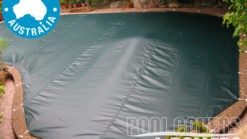
Overview: Leaf and debris Pool covers also known as Winter Cover are typically used on high maintenance pools. They are designed to keep bulk leaves, twigs, and other debris up and off the water level, remaining dry so that the wind or a blower vac can be used to move them on. They were originally made from mesh or shade sail material, however, recently this is moved to polyethylene open weave material which is lighter and more durable This type of cover is typically designed to be installed over the winter months and to stay on for the majority of the non-swimming season. The cover is pinned down by a series of removable cleats, and tension applied to the cleats to keep the material off the water level.
Leaf and Debris Cover Benefits
Benefits:
-
- Water Savings: Prevents up to 50% of pool water evaporation, with an estimated saving of 4,000 litres to 5,000 litres of water per month
-
- Chemical Savings: Reduces chemical usage up to 25%. By reducing the water loss we reduce the chemical loss also
-
- Temperature Increase: There may be a negative impact on temperature increase compared to a pool without a pool cover, as the weave will restrict the amount of UV passing into the pool.
-
- Heat Retention: Zero Heat Retention as it is an open weave and does not sit on the water surface
-
- Convenience: Typically used as a Winter Pool Cover, to reduce maintenance. The cover is pinned down with a series of removable cleats. Putting the cover on and off the pool is typically a 10-15 minute process, therefore is not ideal for pools that have regular use.
-
- Debris Protection: Excellent debris protection, the cover is pulled taught up off the water level, so that the leaves and debris remain dry and they can be removed by the wind or a blower vac. The material being an open weave, allows the rain to pass into the pool, which typically means dirt and dust will also pass through. However, pairing with a Cordless Robot like the InverX leads to excellent results in maintenance reduction. A study by the University of Queensland found that using a leaf and debris cover can reduce cleaning time by up to 80%.
-
- Durability: Leaf and Debris Covers have a Warranty of 5 Years however, typical lifespan of 10+ years
Australian Conditions: Leaf and debris covers are particularly useful for pools surrounded by a lot of trees or pools positioned under deciduous trees in autumn when leaf fall is at its peak. They are particularly useful for Gum Trees, Bottlebrush, Melaleuca and Jacarandas – along with the leaf drop of deciduous trees like Liquid Ambers. Depending on the climate of the location of the pool, this type of cover may be on the pool 8-9 months of the year and removed for the summer period – Or for a couple of months during the Autumn leaf drop. A lot of the time a Leaf Cover is paired with a Robotic Pool Cleaner and placed on an old pool, that doesn’t get a lot of use now that the kids have moved on to their own homes.
To check out our range of Leaf and Debris Pool Covers Click here
4. PolyCarbonate Pool Covers, Slat Pool Covers or Hard Pool Cover
Overview: Polycarbonate pool covers also known as Hard Pool Covers or Slat Pool Covers are a high-end product, that come in a number of different constructions – High Grade PVC, Extrdued PolyCarbonate or Foam Filled PVC most of which are tongue in groove in their assembly. These covers are precisely measured and laser cut to size. They provide excellent Heat Retention properties and Debris Protection properties. Depending on the colour and extrusion type of the material they can also provide excellent solar transfer heat or thermal transfer of heat into the pool (opaque colours or foam filed do not). The vast majority of Slat Covers due to their precise measure and fit and the material’s weight bearing capabilities (70kg+ per square metre) are regarded as Safety Covers. They can be easily operated by remote control or key, as geared winders are typically installed into the pool roller. This product is the most aesthetically pleasing and convenient of all pool cover types, it has excellent heat retention properties aswell as the added Safety aspect, so is widely regarded as the Gold Standard of pool covers, its drawback – price. Expect to pay between $10,000 – $30,000 for this type of pool cover
Polycarbonate Pool Covers, Slat Pool Covers or Hard Pool Cover Benefits
Benefits:
-
- Water Savings: Prevents up to 70% of Water Evaporation, with an estimated saving of 3,000L per month
-
- Chemicals Savings: Reported reduction in chemical usage of 70%, our estimations are closer to 40-50%
-
- Temperature Increase: The Translucent Polycarbonate type will heat the pool via Solar Transfer directly into the water. The Translucent with Black Base Polycarbonate Type will add heat via thermal transfer (heating the air in the polycarbonate slat and warming the black base). The opaque Polycarbonate has lesser thermal transfer properties. The amount in Degrees Celsius of how much heat is transferred is unreported.
-
- Heat Retention: Excellent heat retention properties in excess of 70%. This is achieved by having a significant air pocket in the polycarbonate slat which acts as a thermal barrier.
-
- Convenience: A lot of the Slat Covers are typically mechanised with Automatic rollers, either key or remote operated for ease of use
-
- Debris Protection: Great for Debris Protection. A slatted cover is laser plot cut, so it fits perfectly to the shape of the pool (typically suitable for rectangle pools). Being a Hard material a high pressure hose, some water based detergent, and a soft bristle brush are ideal to clean the cover if it gets dirty
-
- Durability: Typically comes with a 5 year warranty. Can reportedly last up to 20 years
Australian Conditions: Widely regarded as the cover that is suitable for all locations. Typically used in new pool construction on high-end pools, if it is to be retrofitted to an existing pool, the pool will need to be rectangular or have straight sides with a rounded end. Great heat retention properties. Depending on colour excellent Solar Transfer or Thermal transfer capabilities. Keeps out the vast majority of leaf and debris and due to its hard nature, will hold up against a lot of large material also. This pool cover could also be treated as a safety cover, however, a pool fence is still required under Australia’s pool regulations. At present there are two leading companies producing this type of hard pool cover they are the Remco SwimRoll and Sunbather’s Automatic CVX Cover. However, Stay tuned the team at Australis Pool Covers will have a competing product in this sector in the coming months.
5. Safety Pool Covers
Overview: Safety pool covers can also be known as ShutDown Pool Covers. They are typically made of a Cross Woven Vinyl, which is impervious to debris material and water. In Australia the two most common differ slightly in their function. The first looks very much like a Leaf and Debris Cover however, the cleats are lockable, and the material is Vinyl. The second has supporting poles spanning the width of the pool, with anchor points in the corner. The second version comes in a Manual and automatic retraction version. The water bearing capacity starts around 70kg and goes up from there.
Safety Pool Covers Benefits
-
- Water Savings – 99.6% of evaporation reduction. Around approx. 4,000L per month
-
- Chemicals Savings – Almost zero water loss, means next to no chemical loss. Being Vinyl, there is next to no UV light that passes through the material, therefore this type of cover can allow the pool to be completely turned off in the cooler months
-
- Temperature Increase – Zero Temperature Increase due to the material not laying on the water, nor allowing the UV to pass through.
-
- Heat Retention – Zero Heat retention as the material is not touching the water and allowing for thermal transfer
-
- Convenience – The Convenience for the Safety Cover could be measured two ways. During the Winter months the pool is completely shut down, meaning there is zero maintenance required on the pool, making this type of cover exceptionally convenient. During the swimming months, a manual safety cover would be awfully complicated to get on and off of the pool regularly. An automatic safety cover would be significantly more convenient to get on and off of the pool, however, not as convenient as a solar pool cover
-
- Debris Protection – completely eliminated any leaf and debris and dust from the pool.
-
- Durability – approx. 5 year warranty depending on the manufacturer
Australian Conditions: Australian Law requires a pool fence to be installed regardless of whether or not a Pool Safety Cover is used. If you are in a Cold Climate, then a Shut Down Pool Cover could be quite cost effective over the lifespan of the cover. If you are in a temperate climate and the pool will get regular use throughout the year, and if you were adamant that the safety features were required, then you would definitely need to invest in the automatic version, otherwise it would be too difficult to get the cover on and off of the pool regularly.
We believe the best Safety Pool Cover on the market is the Remco PoolGuard, for more information Click Here
How to Choose the Best Pool Cover
Choosing the best pool cover depends on several factors, here are some key considerations:
-
- Purpose:
-
- Determine the primary purpose of the pool cover. Is it to increase the temperature of the pool, retain heat from an external heat source, stop evaporation, reduce cleaning maintenance, safety, or a combination of these factors?
-
- Purpose:
-
- Pool Location and Local Climate
-
- The local climate will impact on this decision, cooler climates will certainly require more heat retention properties, whilst pools in the North of Australia will not need any more temperature increase. Where the pool is located and its surrounding will also determine the type of cover, are there lots of native trees that drop foliage year round, or deciduous trees that have an autumn fall. Is the pool indoors? Is the pool shaded for long periods of time throughout the day
-
- Pool Location and Local Climate
-
- Pool Type:
-
- The type of pool – in-ground or above-ground and the shape of the pool can influence the choice of cover. Generally rectangular pools are compatible with most of the types of pool covers listed. Free-form pools, infinity edge pools have their own requirements and nuances that will effect the types of covers
-
- Pool Type:
-
- Budget:
-
- Budget is a crucial factor. Solar Pool Covers are arguably the most affordable and within this type of cover you have levels of pricing evident. Material made in China is imported extremely cheaply and over the years this material is renowned for not lasting terribly long. However, if you are just needing a cover to meet a Certification requirement like Basix then this might be suitable. Although the European material has improved over the years, Australian made Pool Cover Bubble has a proven track record of lasting longer in Australian Conditions.
Polycarbonate Pool Covers (Hard Covers) and Safety Covers tend to be at the higher end of the Price scale, in particular the Hard Pool Covers as they typically tick all of the boxes, temperature increase, heat retention, water saving, safety and aesthetics.
- Budget is a crucial factor. Solar Pool Covers are arguably the most affordable and within this type of cover you have levels of pricing evident. Material made in China is imported extremely cheaply and over the years this material is renowned for not lasting terribly long. However, if you are just needing a cover to meet a Certification requirement like Basix then this might be suitable. Although the European material has improved over the years, Australian made Pool Cover Bubble has a proven track record of lasting longer in Australian Conditions.
-
- Budget:
-
- Convenience:
-
- As a pool cover typically reduces the aesthetic nature of the pool, the ease and convenience of the product needs to be able to combat its overall negative looks. Automatic covers offer convenience but may require professional installation.
-
- Convenience:
Conclusion
For most pools, a Solar Pool Cover like those sold on https://poolcoversandrollers.com.au/poolcovers/ will be the pick of the pool cover types. It is the most affordable, provides a good amount of temperature increase to the pool naturally and without cost. A Solar Pool Cover has excellent heat retention properties, making it an excellent companion product for Gas Heating, Solar Heating and Electric Heating. Will almost eliminate all water loss through evaporation and hence drastically reduce chemical usage/ loss. As the material is light weight and malleable, if paired with a quality pool cover roller like the Pool Cover rollers available at https://poolcoversandrollers.com.au/rollers/ they are also extremely convenient, taking less than 30 seconds to get on and off the pool for most pools, and if buying an Australian made Bubble, the pool owner will also get the longevity of a product, designed for the Australian climate. However, there are certain circumstances where the requirements of the pool lead the owner to one of the many other different pool cover types available.