Original price was: $28.00.$25.20Current price is: $25.20. sqm
Material & Construction
-
Material: GeoBubble high-performance air-cell pool cover material, engineered for durability and heat control.
-
Thickness: Approximately 500 microns (0.5 mm) — a balance between durability and thermal performance.
-
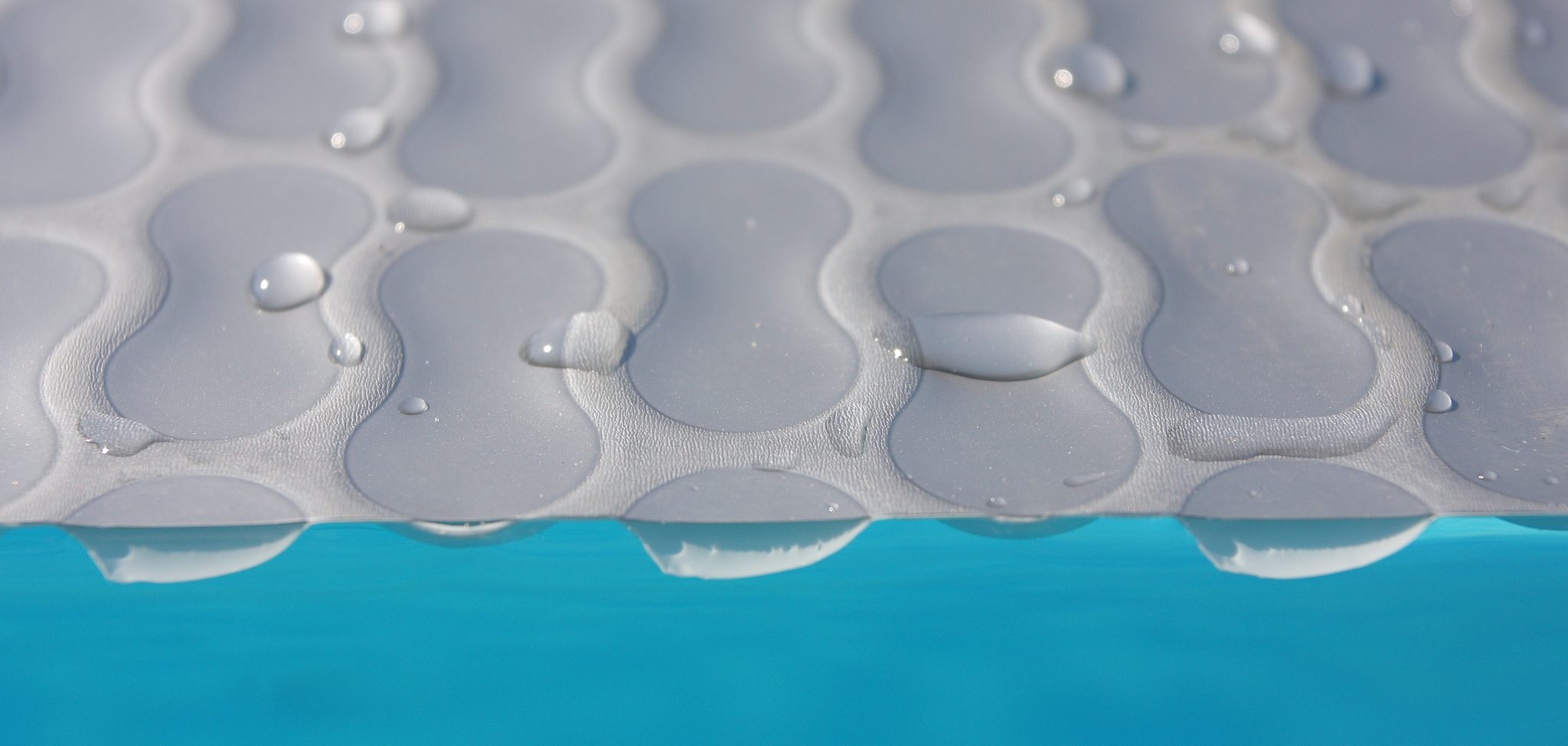
Bubble Design: Patented figure-8 GeoBubble structure to provide enhanced insulation and strength.
-
Top Surface: Silver reflective layer designed to reflect mid-infrared radiation.
-
Underside: White GeoBubble layer to maximise insulation and heat retention.
Performance Metrics
-
Heat Loss Reduction: Up to 57% reduction in heat loss compared to an uncovered pool.
-
Relative Insulation: Up to ~90% of the insulating performance of a traditional 5 mm foam thermal cover, at significantly lower weight and cost.
-
Evaporation Control: Eliminates up to 98% of evaporative losses, a major contributor to heat loss.
-
R-Value: ~0.084 m²K/W (indicative of insulating performance).
-
U-Value: ~11–12 W/m²K (consistent with effective insulating behaviour for a floating cover).
Suitability & Use
-
Pool Compatibility: Suitable for indoor and outdoor pools, heated pools, spas, and hot tubs.
-
Best Application: Designed primarily for heat retention.
-
Weight & Handling: 460grams per sq m. Lightweight relative to foam thermal covers, easier to handle and install.
-
Customisation: Can be made to fit any pool shape and size (custom cut). Parts4Tubs
Durability & Lifespan
-
Expected Lifespan: Typically 6-8+ years with regular use and proper maintenance.
-
Warranty: 8-year pro-rata warranty
-
UV Resistance: 140 kLys/yrs 0.9% Additive. 180 kLys/yrs 1.2% Additive. Enhanced stabilisation for outdoor exposure
🔥 Heat Retention & Energy Impact
-
Reduces heating costs by up to ~57% via reduced heat loss — especially effective overnight during cooler periods.
-
Acts as a thermal cover (heat retention), rather than a solar heating cover, ideal where solar gains are minimal or not needed.
-
Slows radiative heat loss by reflecting mid-infrared heat back into the pool.
💧 Water & Chemical Savings
-
Eliminates ~98% of water evaporation, preserving water volume and conserving the heat already in the pool.
-
Reduced evaporation means lower chemical consumption and fewer top-ups.
🌍 Operational & Maintenance Benefits
-
Easier handling and lighter than traditional foam thermal covers — simpler to roll, unroll and store.
-
Reduces debris infiltration, keeping pools cleaner and lowering maintenance time.
-
Compatible with our Stationary, Mobile and Commercial Pool Rollers .
Smart Water Mark Approved
-
Get Instant Quote
Enter your pool measurements below to get an instant quote.
Out of stock
Description
RaeGuard Thermal Pool Cover by GeoBubble — A Deep Dive into Heat Retention & Thermal Performance and why its potentially a better option than a foam cover
The RaeGuard Thermal Pool Cover is a specialised heat retention pool cover engineered using advanced GeoBubble technology — a patented bubble profile developed to perform in harsh pool environments through improved durability, UV resistance and thermal performance compared with conventional pool covers.
What Makes RaeGuard a Thermal Pool Cover Alternative
Unlike standard solar pool covers that aim to add heat from sunlight, RaeGuard focuses on retaining the heat already in the pool — functioning foremost as a thermal cover alternative optimized for reducing heat loss rather than heat gain. Its design prioritises reflecting radiative heat back into the water and forming a physical barrier that slows thermal diffusion away from the pool surface.
This difference is significant:
-
Radiative heat reflection: The silver-on-top and white bubble underside are formulated to maximise reflection in the mid-infrared spectrum, targeting the portion of heat typically lost from a pool’s surface.
-
Evaporation control: By eliminating up to 98% of evaporation, RaeGuard reduces one of the primary mechanisms of heat loss from a pool — conserving water and thermal energy.
-
Insulative action: The unique GeoBubble figure-8 air cells trap air and act as an insulating layer, further limiting heat transfer away from the water.
These mechanisms combine to lower heat loss and improve overall heat retention, making RaeGuard a dedicated thermal pool cover solution where solar gain is less relevant — such as indoor pools, or shaded outdoor pools where heating systems are already in place.
Heat Retention Compared to Traditional 4.5mm Foam Covers
The Australian market has long been dominated by 4.5mm closed-cell foam thermal pool covers, which are recognised for high insulation value, particularly in indoor environments where solar radiation/ UV Convection heating isn’t utilised. Foam covers perform well as thermal pool covers due to their dense structure and substantial thickness, reducing conductive heat loss significantly. Foam thermal blankets can deliver some of the strongest insulation available in floating covers. quaman Leak Detection+1
However, RaeGuard differentiates itself in a few key ways:
-
Weight and usability: Foam covers as they age tend to be heavier and bulkier, as they start to take on the water into the foam cell, making handling and placement more cumbersome. As the foam takes on the water, it is highly likely that the thermal performance of the cover starts to reduce. RaeGuard, in contrast, remains lightweight and easier to deploy as its a bubble, while still delivering robust thermal performance, throughout its lifespan.
-
Durability in outdoor use: Foam thermal covers are typically tailored for indoor or controlled environments because UV exposure and weather degrade foam faster. RaeGuard, built on GeoBubble material, is designed for both indoor and outdoor performance with enhanced UV stabilisation.
-
Thermal performance relative to cost: Independent testing and manufacturer data position RaeGuard at up to ~90% of the insulation performance of a 5mm foam cover (the typical Australian product is 4.5mm foam)— but with less weight, easier handling, a longer warranty period and a lower effective upfront cost, approx 2/3rds.
For pool owners who primarily want to maintain temperature rather than collect solar energy, RaeGuard is a compelling thermal pool cover alternative to foam — offering practical trade-offs between performance, usability and cost.
Residential Pool Heat Retention: Focus on Everyday Efficiency
In residential contexts, RaeGuard is specifically useful for:
-
Extended swimming season: By slowing heat loss overnight or on cooler days, RaeGuard helps maintain usable temperatures for longer periods.
-
Lower heater demand: Pools with Solar Pool Heating, Electric Heat pumps or Gas heaters, typically see less energy demand to maintain target temperatures, given RaeGuard ability to reduce heat loss by up to approximately 57% compared to an uncovered pool.
-
Water and chemical savings: Since evaporation is tightly controlled, less water and fewer chemicals are lost, reducing operational and maintenance efforts.
For owners with solar covers already installed, RaeGuard can be considered an alternative where solar input is minimal (e.g., shaded pools, cooler climates) and heat retention becomes the priority.
Commercial & Large Pool Applications: Scaling Heat Retention
The advantages of RaeGuard™ are amplified in commercial and larger pool settings:
-
Improved heat retention for larger bodies of water: Because larger pools have greater surface areas — and thus greater evaporation and heat loss — RaeGuard 98% reduction in evaporation and reflective thermal design significantly reduce total energy demand.
-
Cost-effective over large footprints: While foam covers can become prohibitively expensive and difficult to handle at commercial scales, GeoBubble™-based RaeGuard covers maintain manageability with robust thermal performance per square metre. You are getting practically the same thermal performance, that maintains that performance year on year, a product that weighs less (and doesnt take on water), is easier to handle for the staff at a greatly reduce upfront cost.
This makes RaeGuard™ not just a thermal cover alternative — but in many commercial scenarios, a preferred solution where heat retention impact and ease of handling must coexist with budget and maintenance efficiency.
Summary — Thermal Pool Cover Alternative with Practical Efficiency
RaeGuard Pool Covers provide a scientifically tuned blend of reflective and insulative features designed for heat retention without relying on solar gain. Leveraging GeoBubble technology, these covers reduce heat loss through evaporation and radiative pathways, making them particularly suitable as thermal pool cover alternatives to heavier foam options that dominate the Australian thermal market. They balance significant heat retention with ease of use, durability outdoors and adaptable performance across both residential and commercial pool applications — and align strongly with modern priorities of energy efficiency and operational simplicity.
Ultimate Buyers Guide to Pool Covers
You may also like…

Related products
-
Sale!
500 Micron Pool Cover – Suncap
Original price was: $19.80.$18.00Current price is: $18.00. sqm Add To Cart -
Sale!
600 Micron Pool Covers – Suncap
Original price was: $25.00.$23.00Current price is: $23.00. sqm Add To Cart -
Sale!

Sol+ Guard 500 Micron Pool Cover
Original price was: $19.80.$18.00Current price is: $18.00. sqm Add To Cart -
Leaf and Debris Pool Cover
$42.00 sqm Add To Cart